
LA City Council Reviews Racially-Biased Pretextual Stop Policy During Joint Committee Meeting

On Friday, March 6, the Los Angeles City Council’s Transportation Committee and the Ad Hoc Committee on Unarmed Crisis Prevention, Intervention, and Community Services held a special joint session to review LAPD’s policy on pretextual traffic stops. For years, organizers and residents across Los Angeles have raised concerns about these stops—routine police encounters that often begin with minor traffic violations but frequently lead to searches, questioning, and intimidation that disproportionately target Black and Brown drivers.
Leslie Johnson, Vice President of Programs & Organizational Culture at Community Coalition, has been at the forefront of the Promoting Unity, Safety and Health in Los Angeles (PUSH LA) campaign since its inception in 2019. “Six years after the Los Angeles City Council introduced a motion to explore alternative traffic enforcement methods that do not rely on armed police officers, Los Angeles has yet to act on the recommendation to ban pretextual stops,” said Johnson. “The data is clear. The harm is real; we are calling on our elected leaders to bring this recommendation to fruition.”
During the meeting, data presented to the committee underscored what community members have long been saying. LAPD conducts roughly 50 pretextual stops every day, yet two-thirds of those stops result only in a warning. Even more troubling, 86% of those pulled over are Black or Latino residents, highlighting the racial disparities that have fueled calls for reform.
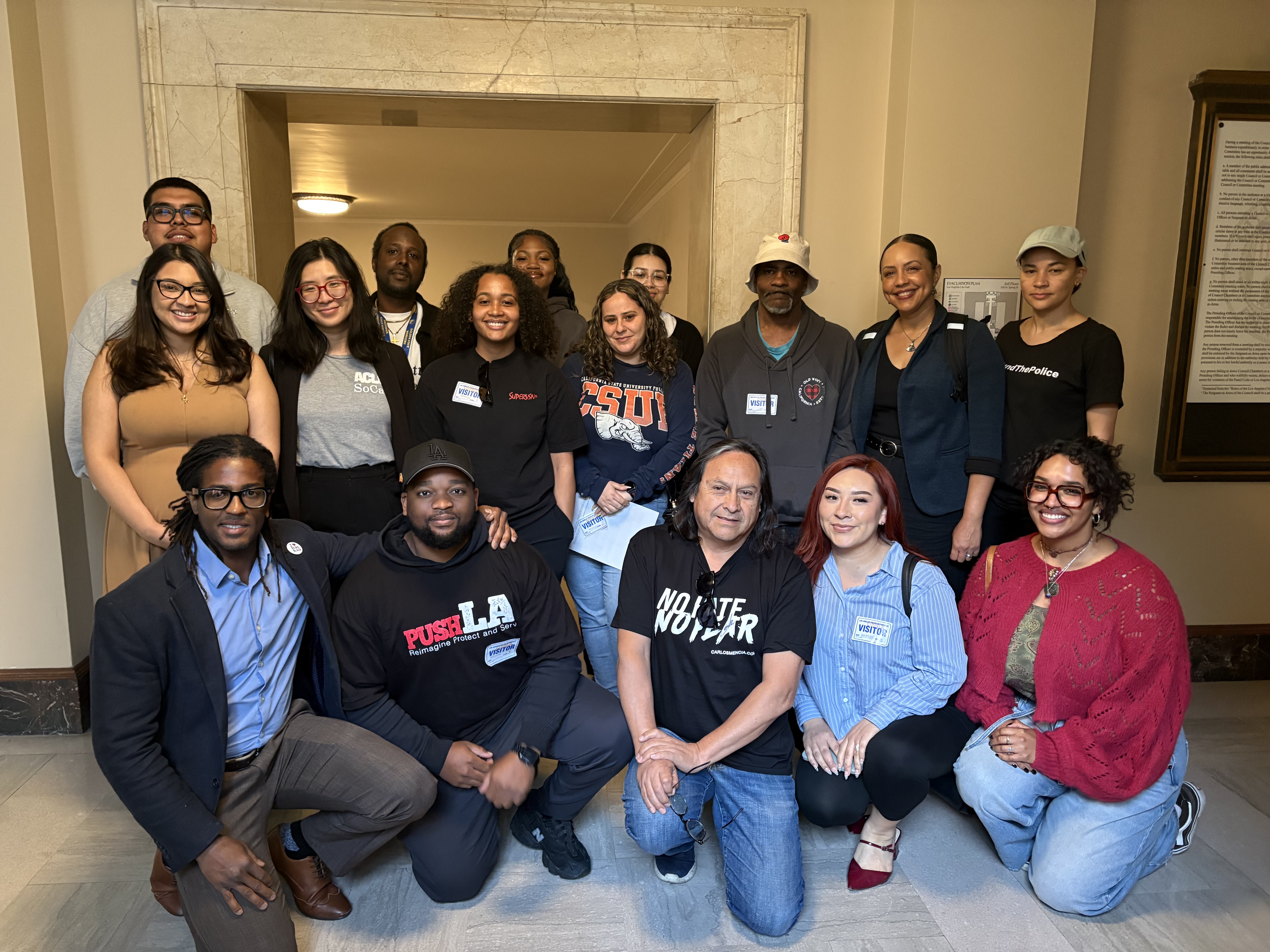
Members of the PUSH LA Coalition and residents directly impacted by these encounters came to City Hall to share their experiences. Among them was community member and S.C.O.P.E. organizer Brian Jointer, who testified about a traumatic traffic stop involving his family.
HEAR BRIAN TESTIFY
“I was pulled over at gunpoint with my teenage sons in the car, 13 and 14, for a nonexistent issue with my license plate,” Jointer told the committee. “I felt an overwhelming sense of helplessness that no father should feel. After forty-five minutes of searching, they left without giving me a ticket, with no explanation and with my belongings scattered on the sidewalk.” He added, “This was my son’s first experience with police officers, and that pains me.”
Community Coalition and Catalyst California, the lead conveners of the PUSH LA Coalition, were invited to present their analysis of the LAPD’s pretextual stop data. Chauncee Smith, Associate Director of Reimagine Justice and Safety, emphasized that cities across the country are already moving to limit these practices.
“The main takeaway is that public policy around the nation is shifting to prevent racially biased stops and end harmful police practices that undermine community safety,” Smith said. “The data speaks for itself. Pretextual stops impact thousands of Black and Brown Angelenos each year, creating generational trauma and eroding trust in our safety systems.”
Elected leaders also voiced support for reform. Assemblymember Isaac Bryan and State Senator Steven Bradford attended the meeting and provided testimony, standing alongside organizers and community members calling for change.
By the end of the session, momentum had clearly shifted. Councilmember Eunisses Hernandez, co-chair of the Ad Hoc Committee, introduced a motion urging the Police Commission to ban pretextual stops in Los Angeles. The motion passed through the joint committee and will now move forward to the full City Council for consideration.
For the organizers and residents who showed up to testify, the hearing was more than a policy discussion—it was a reminder that change only happens when communities show up to speak truth to power. Community members have sounded the alarm about racially biased traffic stops and the harm and trauma they cause. Now, with growing public support and mounting data and evidence, Los Angeles stands at a turning point. The question before the City Council is clear: will LA’s policies continue to criminalize Black and Brown drivers, or will the city choose a path that truly promotes unity, safety, and health for all Angelenos?