
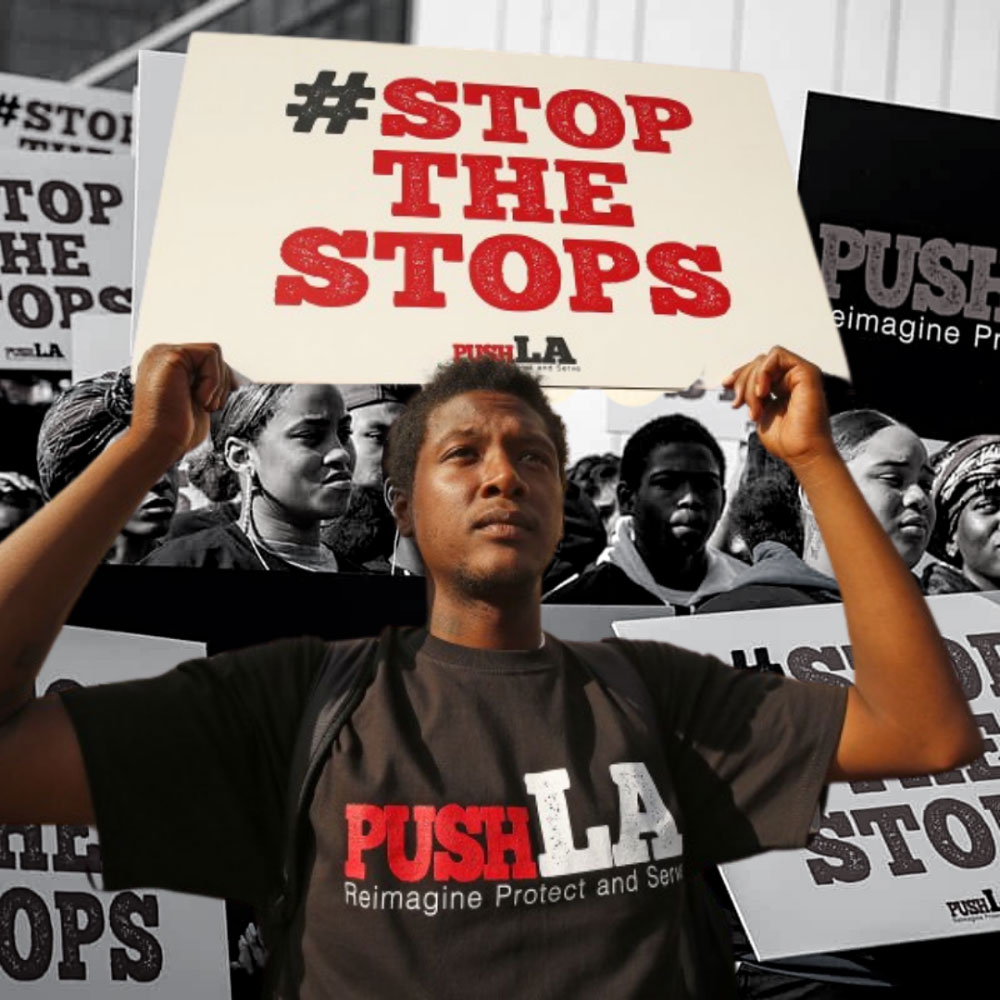

Six years after PUSH LA first advocated to end these stops, and multiple reports detailing the damage to the community and the ineffectiveness of the practice, the Los Angeles City Council voted to ban pretextual stops. This historic vote is not just a symbolic gesture—it’s about structural change.
Click here to view the Stop The Stops Video
“In this city, we took a giant step forward. LA, our city council made a promise … no more hunting of the innocent … and in doing so we have advanced freedom because today’s fight is about freedom,” said Alberto Retana, President and CEO of Community Coalition at the press conference after the historic vote. “The freedom to move around our city without being prey. This freedom is not guaranteed. This policy win is one step, but without continued pressure, without vigilance, without accountability, without reporting, we know that our city will revert to what it has always done. But with our eyes, our organizing, our movement, we will not go back!”
What does the vote mean?
It narrows the reasons police can stop people. A ban draws a clear line: minor infractions—like a broken taillight, expired tags, or an air freshener—can no longer be used as a gateway to investigate unrelated suspected crimes without real cause. That removes one of the most commonly used entry points into police encounters.
It reduces unnecessary contact with law enforcement. Traffic stops are the front door to policing. By limiting low-level stops, the city is actively reducing the number of interactions that can escalate—especially the ones that have historically turned deadly.
It directly targets racial profiling. Pretextual stops have long been a tool that disproportionately impacts Black and Brown drivers. A ban is an acknowledgment—backed by data—that these stops are not applied equally and that public safety cannot come at the cost of over-policing specific communities.
It shifts the definition of “public safety.” Instead of equating safety with more stops, more tickets, and more enforcement, the policy signals a move toward harm reduction: fewer escalations, fewer traumatic encounters, and fewer opportunities for violence.
It forces a reallocation of resources. When officers are no longer spending time on minor equipment violations, departments can prioritize serious safety issues.
It creates accountability—and a new standard. It sets a national precedent. Other cities like Philadelphia, San Francisco, and Chicago have taken steps, but Los Angeles becomes the model—and leveraging partner for other cities.
It interrupts a pipeline—from minor traffic violations to life-altering (or life-ending) encounters.
It affirms the right to move freely without fear. No one should have to second-guess a drive to work, school, or the store. As South L.A. resident Brian Jointer expressed during a public comment period at City Hall, “Driving with my sons to celebrate my oldest son’s birthday, [LAPD] followed me for a mile before pulling me over citing a nonexistent issue with my back license plate. … What followed was an encounter that no father should have to endure. Sitting on the curb, with my sons beside me, I had an overwhelming sense of helplessness. After 45 minutes of searching my car, the officers left my belongings scattered on the sidewalk–leaving me with no ticket or no explanation, only embarrassment and humiliation.”
This policy is about ensuring that Black and Brown residents are not criminalized for simply being on the road—and that freedom of movement is treated as a right, not a risk.
It’s not the finish line. The vote was a policy decision. The real impact will depend on implementation by LAPD and the Police Commission. It will mean a zero tolerance policy for those who do not adhere to the ban. It will mean accurate data tracking, and enforcement mechanisms to ensure the ban is followed in practice.